Buy the Dip
After a more-than-solid 2013 in the stock market, 2014 has started off with mixed results. The first 15 days of the year showed continued gains and momentum offered by 2013. Then the pullback struck with a near 6% drop over the course of the next 20 days. While the pull back has been swift, the data shows that there are some clues and comforts to worried investors. Since March of 2009 (when our bull market began), there have been a total of 19 “plunges” of 5% or more. The average duration of the plunge is 25 days with very few of these plunges dipping into the double digits. We are nearing that 25 day window and believe, as Jeff Kleintop, chief market strategist at LPL Financial states*, that we should buy the dip and get into a wide mix of equities at discount prices.
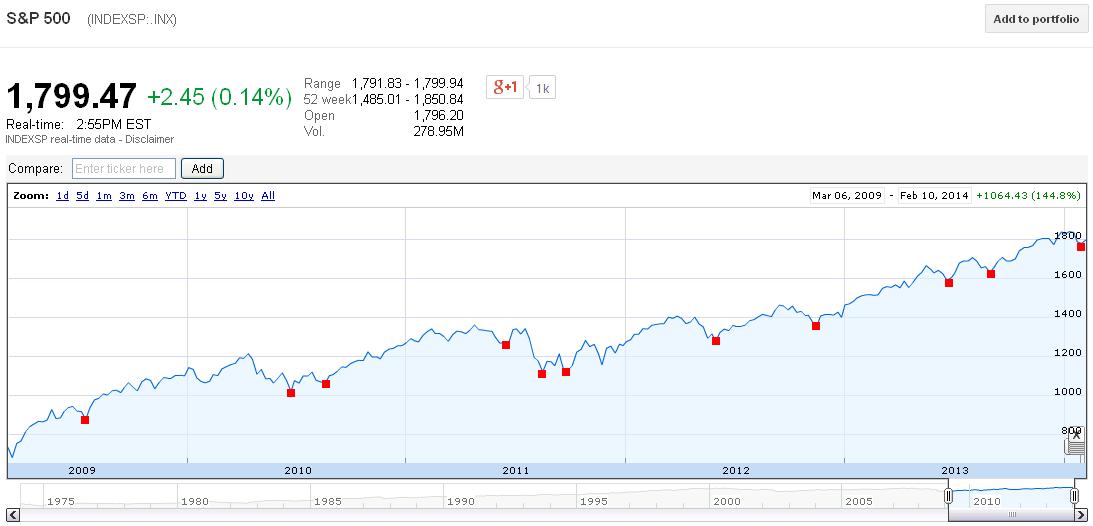
noteable “dips” since March 2009
* Source Adam Shell USA Today
Categories: Data Insights, Investing Ideas Tags:
2013: Stocks Soar
Stock market gains in 2013 surely outweighed their performance in 2008! In most instances, your 401k and any “aggressive” style investments you have should have topped – or at least hovered near – 20%. If you had time to take a look back at 2013, the S&P 500 topped 31% which as Jeff Kleintop of LPL Financial writes, isn’t all that rare and that years like this are typically “followed by several years of strong gains.”

So what can we attribute the gains in 2013 to? Mostly – a little bit of everything from improvement in the private job sector, a “recovery” of sorts in housing, quantitative easing and your general consumer spending more. GDP increased month-over-month from for the entire year while unemployment slowly sank to around 7%. The biggest question remains: what’s going to happen in 2014?
I don’t see a correction coming, in fact, I see another solid year in 2014 in the scope of 10-15%. In screening stocks for the upcoming year, I would stay away from anything that seems overbought or had a “meteoric rise” in 2013 ( NFLX, FNMA, FMCC, ZLC, BBY, TLSA). I do like technology stocks and industrial as well as cyclical and discretionary products. (DIS, HD, SBUX, GE, MMM, GOOG,V to name a few) and I do like stocks that pay a dividend. I’d also look for “good” companies that post a negative earnings surprise. If you seek those out, I’d advise to buy a day or two after the surprise and hold it until just before the next earnings announcement. This allows you to buy a “fundamentally sound” company at a “relative discount”.
This year at StockDataTrends.com, we are going to be building out new data elements to help you – the individual investor – make informed descisions on what stocks are good for the short term play and what positions you should hold on to.
Categories: Data Insights, Investing Ideas Tags:
Election Day & The Stock Market
There are a number of economic factors that affect the stock market: earnings, jobs, supply, m&a; but we wondered historically how the market performed during and after an election day.
Thankfully, the guys over at StockCharts.com helped shed some light on it.
You can read the article here: http://stockcharts.com/help/doku.php?id=chart_school:trading_strategies:the_pre-holiday_effe
Categories: Data Insights, Investing Ideas Tags:
Data Insights on the Success of SWHC
Here is an article that correlates the uptrend of SWHC and National Instant Criminal Background Check System requests.
To sum up the article, the more people having their backgrounds checked correlated to a higher number of firearms purchases.
http://seekingalpha.com/article/721321-trading-options-on-smith-wesson-reloaded
http://www.fbi.gov/about-us/cjis/nics/reports/050312-1998_2012_monthly_yearly_totals.pdf
Categories: Data Insights, Investing Ideas Tags:
What Beta is Beta?
There is a lot of information out there regardless of your skill level in investing. So what sources can you trust and why is this important? A lot of people only look online at their favorite website to check P/E ratios and Betas without knowing how those calculations are created. Further, many people are not aware that websites such as Yahoo finance, Google finance and the NYSE calculate their values differently. This may be surprising at first, but even if you already knew this, how do you decide which website is displaying the most accurate Beta for your stock?
We know that Beta is the best measure of systematic risk for the individual investor. But the answer can be found in how the statistics are captured, which is what we help explain. You may not have thought about standard deviation since that brief moment in high school or college, and may have never heard of covariance, but these statistics, and how they are captured, are critical to the way beta’s are calculated.
To put Beta in definable terms, the various Betas you will observe online are due to what market portfolio (such as the S&P500) the stock is compared to, as well as how the returns are averaged over a period of time. Beta numbers will change drastically depending on if the returns are collected based on the past three years versus five, weekly returns versus monthly, if various adjustments for economic trends are used, if the company takes on more leverage, and how frequent the stock trades. Beta in its simplest form can be described as the Relationship the returns of your stock has to the returns on the market, divided by how much the market fluctuates (Covariance of a single Stock’s returns to the Market returns /Variance of the Market).
This is why, if you do not know what market your stock is being compared to, and how often the returns are being calculated (as well as averaged), you will not know how accurate the Beta displayed is. This can lead to confusion, and is why pulling Beta from a single source to balance your portfolio risk can be misleading.
Therefore, if you know how the website is calculating its beta, you can better choose if the assumptions made are accurate for the time period you intend on holding the stock as well as its contribution to your portfolio risk. If you want further confidence, you can compare the average betas for your stock to the average of other companies that are comparable to your stock.
Categories: Data Insights, Investing Ideas Tags:
Iran & The Stock Market
With the mounting tensions surrounding Iran’s development of Nuclear Technology there are certain to be some implications to a number of market sectors.
Acting on the threat to close the strait of Hormuz – Anyone who has studied a simple supply and demand curve knows that if the supply of oil decreases from our top exporters the price will go up. A rise in oil prices obviously causes the price of gas to go up. That in turn effects the price of goods due to fuel (a byproduct of OIL) prices that manufacturers have to eat. Those manufacturers still need to make money and a rise in the price of consumer goods is where we will see it.
Unless Iran has a Navy that the rest of the world has yet to discover, I wouldn’t count on the 30 mile wide straight being “shut” for long. World powers have threatened military action on “anyone” closing the straight or affecting free trade. The simplest play here might be ETF: OIL. You’ve probably already missed the fun money you could have made in October 2011 or at the beginning of this month, but a definitive military closing of the strait would cause a spike in OIL for a few days and a chance to make a good return over that time.
Cuts in oil exports to Europe (Greece/Italy) – Again, this is a supply and demand thing. Iran has already cut supply to the UK and France. While both of those countries rely on a small portion of Oil from Iran, Italy and Greece more heavily import Iranian Oil. With the likes of Italy and Greece looking for Oil elsewhere, that will have to be derived from the “overall supply” which again drives the supply down and the price up.
Cuts in oil exports to India/China – This situation is similar to the above, but really doesn’t leave Iran a leg to stand on. Since well over 50% of Iran’s GDP is based on Oil exports, a cut in exports to Asia might have a crippling effect on the Iranian economy.
A Declaration of War – January 12, 1991, September 14, 2001 & March 3, 2003 all have something in common. They were days that the US congress authorized military engagements or declarations of war in the middle east. In looking at market data trends from these time periods, we see a sharp dip in the overall market followed by a swift recovery (around 2 weeks). This is consistent with investor fear and uncertainty. The word ‘war’ alone is enough to make the investing public feel a little queasy. An interesting play here might be SDS. I will warn you though that SDS is not for the feint of heart. SDS is an index that corresponds to twice (200%) the inverse (opposite) of the daily performance of the S&P 500 (the Index). So if S&P500 is down 20 points, you’re up 40… The name of the game here is timing entry’s and exits properly.
Iran is actually developing for energy purposes – Complete market volatility and wavering investor confidence. Oh wait…
Categories: Data Insights, Investing Ideas Tags:
Getting the “Skinny” on Vivus
I am probably going to have a little too much fun with this one, but if you had shares of Bio-pharmaceutical Company Vivus (VVUS) you’re feeling “fat” from the profits you made today and its time to unload and take a slice of the pie (profits). Vivus Inc’s Qnexa was a promising obesity drug that’s had its fare share of rejections from the (overweight) US FDA over the past few years citing health and safety concerns. Today a panel recommended approval for the drug saying that treating obesity “over-weighed” the potential cardiovascular risks and potential birth defects.
That reminds me of those commercials we have all seen where the softly toned lawyer type speaks at the end of a pharmaceutical commercial about the potential side effects that include (blindness, death and a potential gamut of other horrible health issues). Speaking of which; time for me to hit the gym. Expect further upside if/when the drug actually does get approved (April 17). We will keep a close eye on this one and will probably be a buyer on the 16th and a seller the day after for some quick money.
Metro PCS (PCS)
Destroyed the original guidance from Wall Street’s 9 cents per share earnings. Up over 15% at the end of day, PCS attributed its strong earnings to it’s fairly competitive lineup of Smart Phones along with its consistently growing (contract free) subscriber base. Look for earnings in the next quarter to be more on par with Wall Street’s expectations, and not a significant (like we saw today) jump in price. With strong fundamentals and significant profit growth, we see this as a buy and hold. If you can buy in the low 11′s you’ll be getting a really good deal.
Categories: Data Insights, Investing Ideas Tags:
Twitter Predicts the DJIA
Social Media is changing how people interact basically every day. From Facebook to Pinterest to Youtube, people are ingesting social media more than anyone could have originally imagined. On the horizon, a number of respectable scientific organizations are using data gleaned from these social media platforms to do everything from predict consumer behavior to predicting economic performance. In behavioral economics, the most basic premise is that markets aren’t rational sytems, rather expressions of human emotions including greed and fear. Seemingly scientists at the Indiana University have set out to prove that Twitter has become an excellent predictor of behavioral economics.
Professors Johan Bollen and Huina Mao of Indiana University, and Xiao-Jun Zeng of the University of Manchester recently wrote a study with findings that gauge “collective mood states” of the investing public and can correlate those changes in mood states to the Dow Jones Industrial Average. In the study, they found statically significant correlations that could predict a market shift nearly 3 days in advance with more than 85% accuracy. Hedge fund and investment managers have taken notice!
What would you do if you knew what the Stock Market is going do before it does it?
Categories: Data Insights, Investing Ideas Tags:
Stock Data Trends Launches
Welcome to StockDataTrends.com! Here you will find incredible insights for stock market data analysis to help you make effective investing decisions.
Our process involves:
- Capture of publicly available financial data points that we can apply in comparative analysis against stock market data.
- Cluster the data by discovering groups and structures in the stock market data that are in some way or another similar without using known structures in the data.
- Detect anomalies in the data that that seem “unusual”.
- Apply association rules and a regression formula against all of the data that we have captured. Here we search for relationships between the variable pieces and attempt to find a function which closely models the data with the least amount of error.
- Once all of our data models have been applied we summarize what we know to assist in making our stock market decisions.
What you get is a wide array of analytical data driven investing insights.
Categories: Data Insights, Investing Ideas Tags: